Compounding Quietly: How Dividend Aristocrats Can Build Generational Wealth on an Everyday Salary
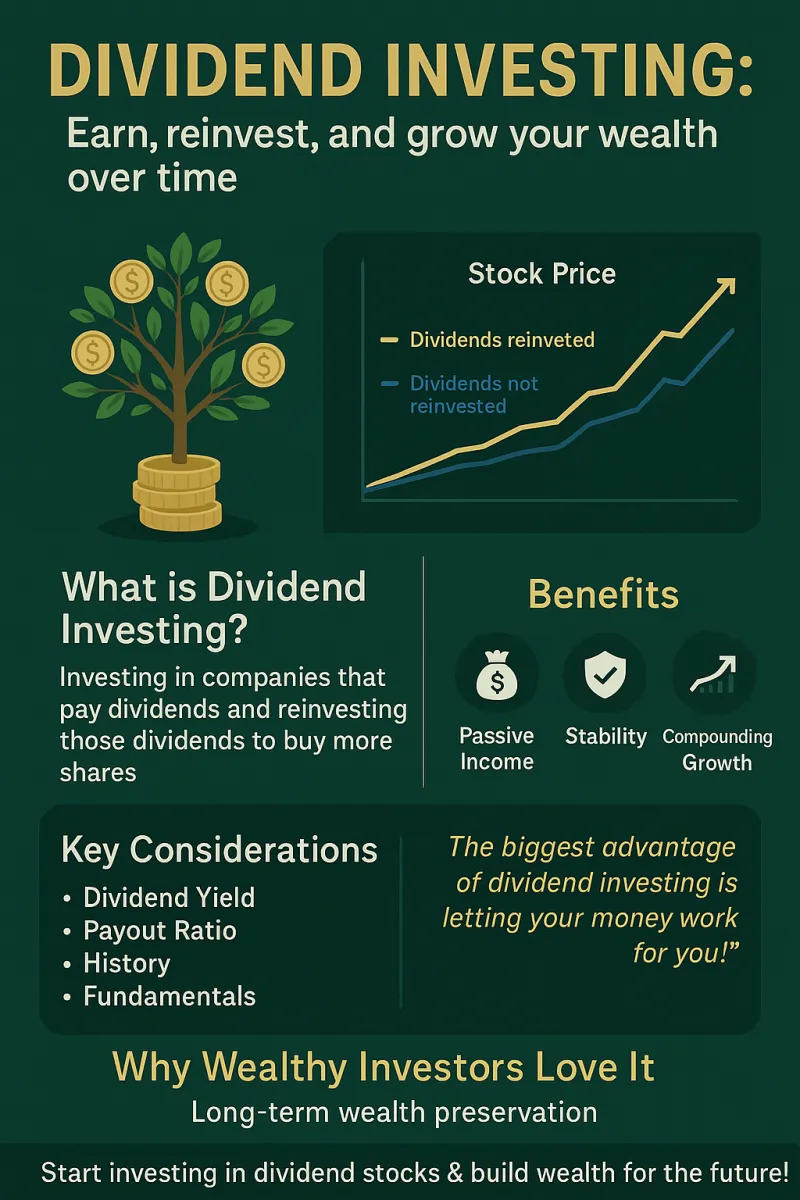
Photo: dividend investing compound interest stock market wealth building, via i.pinimg.com
When most people think about building serious wealth in the stock market, they picture fast-moving trades, hot tips, and dramatic price swings. Yet some of the most enduring fortunes have been assembled in near silence—through patient ownership of companies that quietly raise their dividend payouts year after year, decade after decade. This approach, centered on what are formally called Dividend Aristocrats, is not glamorous. But for the average American household looking to grow net worth on a middle-class income, it may be the single most reliable strategy available.
What Exactly Is a Dividend Aristocrat?
The term "Dividend Aristocrat" refers to a company listed on the S&P 500 that has increased its dividend payment to shareholders for at least 25 consecutive years. As of the most recent annual reconstitution, there are approximately 65 to 68 such companies on the official list, maintained and tracked through the S&P 500 Dividend Aristocrats Index.
These are not obscure businesses. Names like Johnson & Johnson, Procter & Gamble, Coca-Cola, and Automatic Data Processing populate this list. What unites them is not sector or size, but rather a demonstrated ability to generate consistent cash flow—even through recessions, market crashes, and global disruptions—and return a growing share of that cash directly to shareholders.
Raising a dividend for 25 or more years without interruption is a remarkably high bar. It requires disciplined management, durable competitive advantages, and financial structures that can weather economic turbulence. By definition, a company cannot fake its way onto this list for long.
Why This Strategy Resonates With Warren Buffett's Philosophy
Warren Buffett has never explicitly endorsed a "Dividend Aristocrats strategy" by name, but the underlying logic maps almost perfectly onto the investment principles he has articulated for decades. Buffett famously favors businesses with wide economic moats—structural advantages that protect profitability over time. He values predictable earnings, strong brand loyalty, and management teams that allocate capital wisely.
Dividend Aristocrats, almost by construction, tend to satisfy each of these criteria. A company that has raised its dividend through the dot-com bust, the 2008 financial crisis, and the COVID-19 pandemic has demonstrated precisely the kind of resilience Buffett prizes. Holding such businesses for the long term and reinvesting dividends—allowing compounding to do its work—mirrors the approach that built Berkshire Hathaway's portfolio into one of the most valuable in the world.
The key insight is that compounding does not require extraordinary returns. It requires consistency and time. A 3% dividend yield that grows at 6% annually will double your income stream roughly every 12 years, even before accounting for share price appreciation.
How to Identify and Evaluate Dividend Aristocrats
Accessing the official list is straightforward. ProShares, S&P Global, and numerous financial data providers publish updated rosters. However, inclusion on the list should be the beginning of your research, not the end of it. Consider the following analytical checkpoints before committing capital:
1. Payout Ratio This measures what percentage of earnings a company distributes as dividends. A payout ratio below 60% generally signals that the dividend is well-covered and leaves room for future increases. Ratios above 80% may indicate that dividend growth is unsustainable, particularly during earnings downturns.
2. Free Cash Flow Earnings can be influenced by accounting decisions; free cash flow is harder to manipulate. Look for companies whose free cash flow comfortably exceeds their total dividend obligation. This cushion protects the payout during lean quarters.
3. Debt-to-Equity Ratio Highly leveraged companies face greater risk of cutting dividends when credit markets tighten. Aristocrats with manageable debt loads—particularly those with investment-grade credit ratings—tend to maintain their dividend streaks through difficult periods more reliably.
4. Dividend Growth Rate Not all 25-year streaks are equal. A company raising its dividend by 1% annually is technically an Aristocrat, but the real wealth-building power comes from businesses growing dividends at 6%, 8%, or higher. Seek out companies with a 5- and 10-year dividend growth rate that meaningfully exceeds inflation.
5. Industry Diversification Aristocrats span consumer staples, healthcare, industrials, financials, and more. Building a portfolio that spans multiple sectors reduces concentration risk without sacrificing the quality filter that the Aristocrat designation provides.
A Practical Framework for Middle-Class Investors
You do not need $500,000 to start. The mathematics of dividend compounding favor those who begin early and contribute regularly, regardless of account size.
Consider the following approach:
-
Open a tax-advantaged account first. A Roth IRA allows dividends and capital gains to grow entirely tax-free. For 2024, the contribution limit is $7,000 annually ($8,000 if you are 50 or older). Maximizing this vehicle before taxable accounts can meaningfully accelerate after-tax compounding.
-
Automate monthly contributions. Even $200 to $400 per month invested consistently into a diversified basket of Dividend Aristocrats will accumulate substantially over 20 to 30 years. Automation removes emotion from the equation.
-
Reinvest all dividends. Most brokerages offer a Dividend Reinvestment Plan (DRIP) that automatically converts dividend payments into additional fractional shares. This is the mechanism through which compounding truly accelerates.
-
Rebalance annually, not reactively. Aristocrats are long-term holdings. Rebalancing once per year to maintain your target sector allocations is sufficient. Frequent trading erodes returns through transaction costs and tax inefficiency.
The Role of ETFs in This Strategy
For investors who prefer a more hands-off approach, exchange-traded funds tracking the Dividend Aristocrats index offer a convenient alternative. The ProShares S&P 500 Dividend Aristocrats ETF (ticker: NOBL) is the most widely followed, providing diversified exposure to the full list with a single purchase. Its expense ratio is modest, and it rebalances automatically as companies enter or exit the index.
Using NOBL or a comparable fund as a core holding, supplemented by individual Aristocrat positions in sectors you understand well, can provide both simplicity and customization.
Patience Is the Real Edge
The Dividend Aristocrats strategy will not make headlines. It will not generate the kind of short-term excitement that drives social media engagement or brokerage app notifications. What it will do, for investors who remain disciplined over a period of decades, is build substantial, compounding wealth that grows more powerful with every passing year.
In a market environment frequently dominated by speculation and noise, the quiet consistency of a rising dividend is one of the most honest signals a company can send. For the middle-class investor willing to look past the hype, that signal is worth following.